
Skip to main
University-wide Navigation

See a Classic Come to Life on Stage!

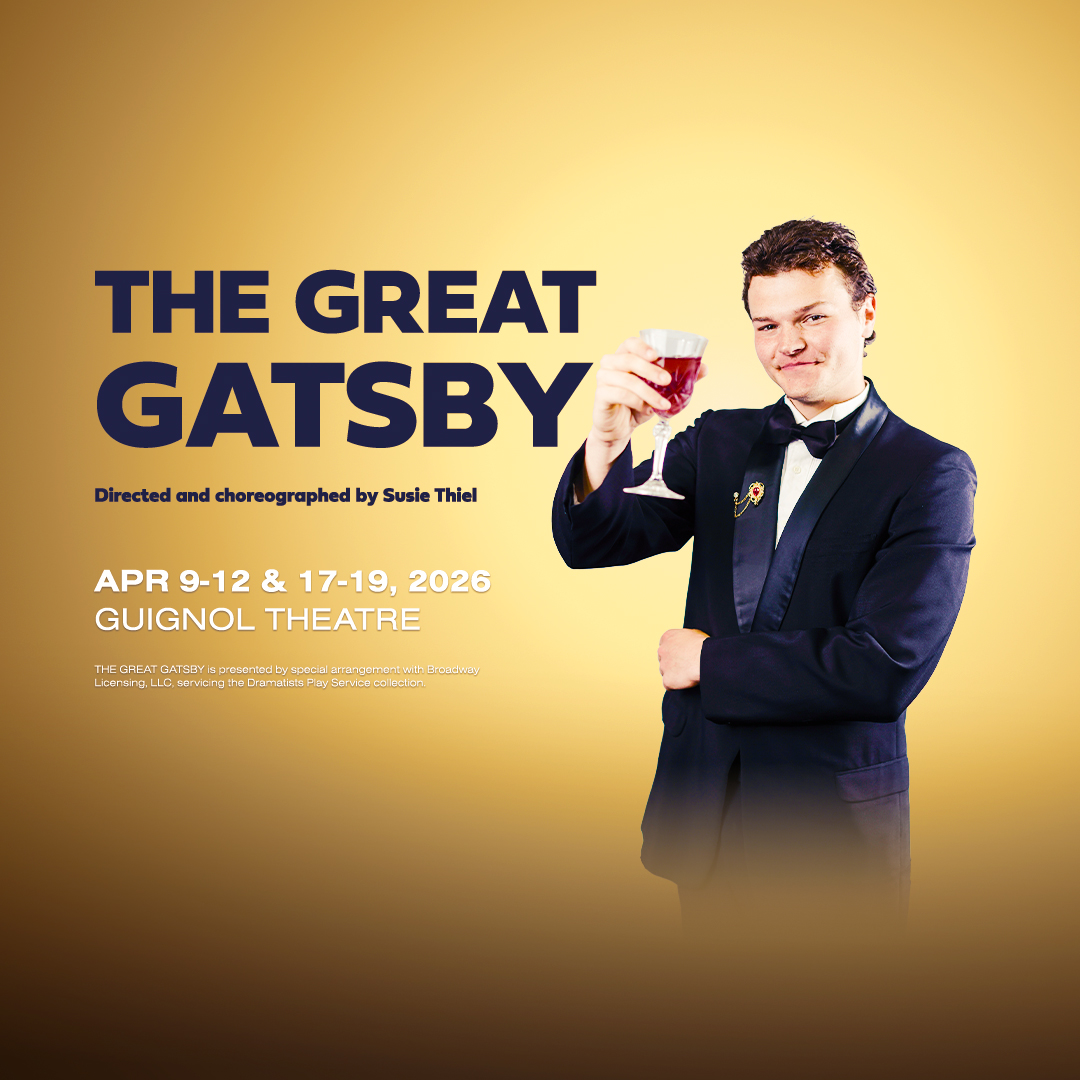
Step into the dazzling world of The Great Gatsby—brought to life in a live theatrical production. Written by F. Scott Fitzgerald, this iconic American novel explores ambition, friendship, love, and the cost of chasing a dream.

Set in the roaring 1920s, the story follows the mysterious millionaire Jay Gatsby and his lavish parties, all driven by his hope to reclaim a lost love. Beneath the glamour and excitement lies a powerful story about identity, choices, and what it really means to succeed.

Seeing The Great Gatsby on stage allows students to experience Fitzgerald’s timeless story in a whole new way—through live actors, movement, design, and emotion. This production transforms a classic novel into an unforgettable theatrical experience, making literature vivid, accessible, and exciting.

Don’t just read the story—watch it come alive.
Tickets

Student Matinee: Friday, April 17 10-12 pm

To request information and begin the ticketing process, please email the department of Theatre and Dance at sarah.smith0@uky.edu. $10 per student.

The show runs approximately 2 hours with one intermission.

There is an optional Q&A after the show that will last approximately 30 minutes.

Student Matinee Tickets

Get tickets

Grants and Subsidy Resources


About the Author F. Scott Fitzgerald

F. Scott Fitzgerald (1896–1940) was an American novelist and short story writer best known for The Great Gatsby. Writing during the Jazz Age, Fitzgerald captured the excitement, excess, and underlying disillusionment of 1920s America. His work often explores ambition, identity, class, and the American Dream. 

Story Overview

Set in the 1920s, The Great Gatsby follows narrator Nick Carraway as he becomes entangled in the glamorous and mysterious world of his neighbor, Jay Gatsby. Gatsby’s lavish parties hide a singular goal: winning back Daisy Buchanan, the woman he loves. As the story unfolds, the characters’ dreams collide with reality, revealing the cost of obsession and illusion. 


Key Themes to Watch For

  • The American Dream – What does success mean, and who gets access to it?
  • Appearance vs. Reality – What is real beneath the glamour?
  • Class & Wealth – Old money vs. new money
  • Love & Obsession – When does hope become destructive?
  • Identity & Reinvention – Who do we choose to be? 

Before the Performance

Discussion or Journal Prompts 

  • What expectations do you have when seeing a novel performed live? 
  • How might music, movement, and design help tell a story differently than a book? 
  • What do you already know about the 1920s? 

Vocabulary Preview 

  • Jazz Age 
  • Prohibition 
  • Symbolism 
  • Narrator 
  • Motif 

During the Performance

Encourage students to observe: 

  • How actors physically portray characters 
  • Use of costumes, lighting, and set to establish time and place 
  • Moments where emotion or meaning is clearer on stage than on the page 

After the Performance

Reflection Questions 

  1. How did the live performance change your understanding of the story or characters? 
  2. Which scene was most powerful on stage, and why? 
  3. What theatrical elements helped communicate the themes? 
  4. How did the dancing add to the storyline? 

Compare & Contrast Activity 

  • Choose one scene and compare how it works in the novel versus the stage version. 
  • What was added, removed, or emphasized? 

Creative Extension Activities

  • Design a set or costume concept for a character 
  • Rewrite a scene from another character’s point of view 
  • Create a playlist that represents Gatsby’s world 
  • Perform a short monologue inspired by the story 

Why Does Theatre Matter?

Live theatre allows stories to be experienced in real time, through human connection. Seeing The Great Gatsby performed helps students engage with literature in a dynamic way, strengthening comprehension, empathy, and critical thinking. 


The Great Gatsby Student Matinee

The Great Gatsby